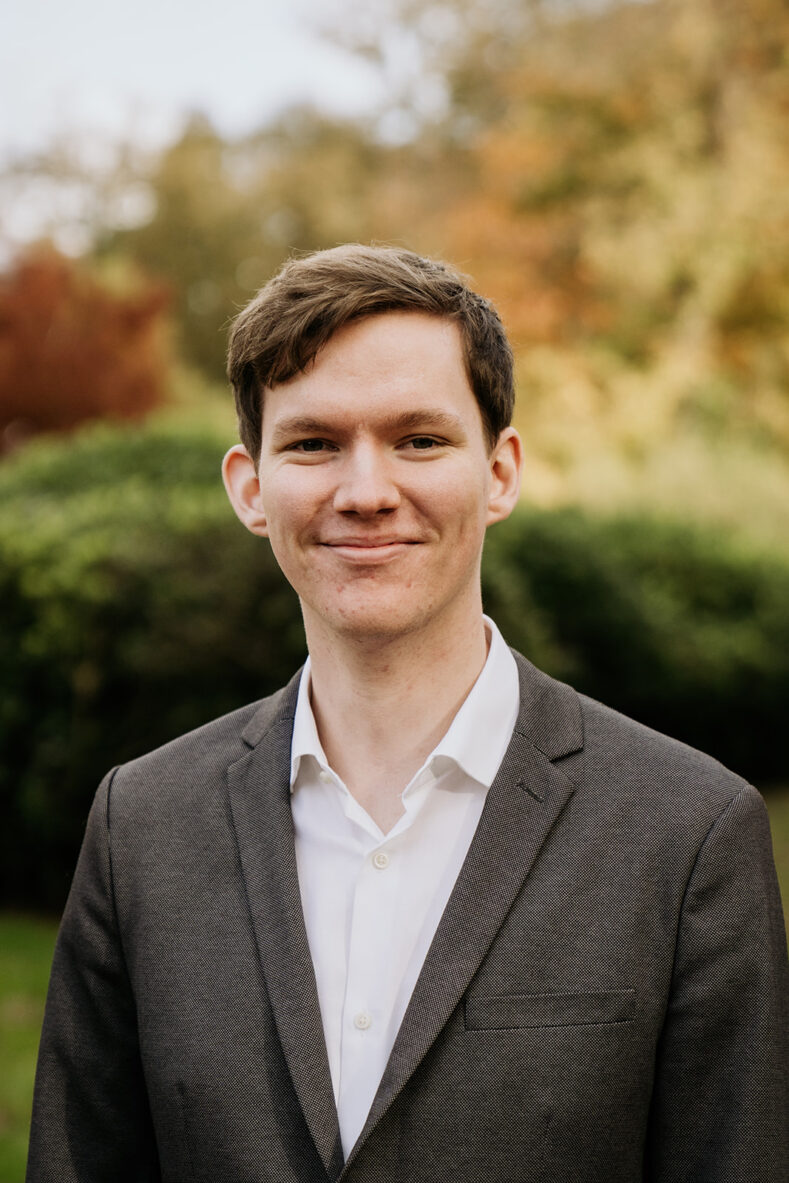
Leuven, Belgium – 13 November 2026 – Today, COSIC (KU Leuven) announced that Thomas de Ruijter, PhD candidate in Electrical Engineering, has been selected as a recipient of the 2026 Google PhD Fellowship Program with support from Google.org.
Thomas de Ruijter will receive direct funding to make Fully Homomorphic Encryption (FHE), which allows computation on data while it stays encrypted, practical through algorithm-hardware co-design.
Thomas de Ruijter is among 148 new PhD fellows across 38 countries selected this year through $13 million in funding from Google.org, deepening its commitment to early-career scientists who are advancing the “science of AI” for the public good. Beyond direct financial support for doctoral studies, which gives researchers the freedom to pursue high-risk, high-reward foundational questions, every fellow is welcomed into a lifelong global peer network.
FHE allows arbitrary computation on encrypted data, securing sensitive data during computation, transit and at rest, but its adoption is held back by overheads of several orders of magnitude. On modern platforms, memory footprint, bandwidth and data movement dominate FHE runtime and energy, yet these factors remain largely absent from the cost models that guide FHE algorithm design, and hardware accelerators work around this memory pressure rather than removing it. Supervised by Prof. Ingrid Verbauwhede, Thomas tackles this through algorithm-hardware co-design: by making memory costs explicit, he rethinks core FHE building blocks and validates the resulting designs in an accelerator, shifting FHE from memory-bound toward compute-bound performance. The fellowship’s funding and support give him the opportunity and resources to pursue this research, including large-scale compute that makes it possible to explore and evaluate memory-aware FHE designs at a scale that would otherwise be out of reach. With this support from Google.org, Thomas will be able to demonstrate that memory-aware algorithm-hardware co-design makes encrypted computation practical.
“Today, data is encrypted when it is stored or sent, but it has to be decrypted the moment we want to use it. FHE closes that gap, and this fellowship allows me to work on making it fast enough to be used in practice,” said Thomas de Ruijter, PhD researcher at COSIC, KU Leuven.
“Every major leap in technology starts with a researcher asking a bold question long before the world sees the answer,” said Leslie Yeh, Director of Scientific Progress, Google.org. “The 2026 Google PhD Fellows are asking those questions today. With funding and a global community behind them, exceptional early-career scientists like Thomas de Ruijter at KU Leuven have the freedom to pursue ambitious ideas and help build a stronger, more representative scientific landscape for everyone.”
Since 2009, the Google PhD Fellowship Program has supported more than 1,100 graduate students worldwide. Over the past 17 years, alumni of the program have gone on to become tenured professors, startup founders, open-source pioneers, and research leaders helping shape the future of technology.
Meet all 2026 Google PhD Fellows