lowRISC was ported to Zedboard in COSIC by Furkan Turan to design and verify trusted computing hardware extensions.
Porting lowRISC to Zedboard
Zedboard is versatile development board utilising Zynq SoC. It has been used in several implementations of RISC-V; hosting it as a neighbour to the Zynq’s hard-coded ARM cores. However, in Zedboard the ARM cores of the Zynq are dominant: almost all peripherals or ports connect to the ARM Processing System (PS), and they are not directly reachable from Programmable Logic (PL). That makes the RISC-V, implementated in PL, inaccessible without passing through the ARM PS. Therefore, the RISC-V implementations for Zynq (including the original release by Berkeley or the earliest lowRISC design) use so called Host/Target Interface (HTIF), which has the front-end server running on PS and communicating with the target RISC-V implemented in PL, which is the tethering of RISC-V to ARM.
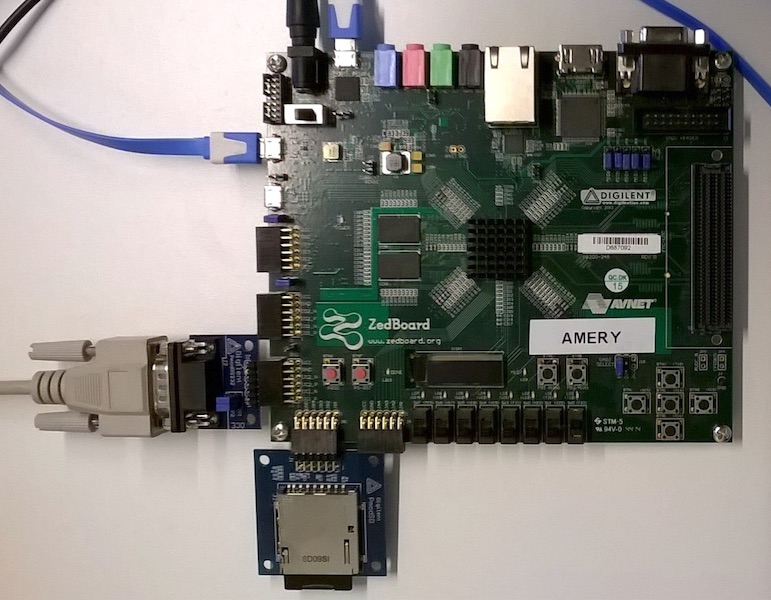
Compared to the other RISC-V implementations, lowRISC’s achievement of offering an untethered RISC-V implementation is great; however, made the design leave the Zynq devices initially. However, with the implementation described in this page, the Zedboard support is added again. Zedboard’s SD Card and UART ports are connected directly to ARM; therefore, the port of lowRISC to Zedboard requires obtaining two low-cost PMOD modules to provide RISC-V with dedicated IO, and continue working untethered.
- For SD Card: Pmod SD
- For UART: Pmod RS232 or Pmod USBUART
Together with the PMODs, the board looks like it is in the image below:
Dedicated IO is provided to RISC-V with PMODs; however, the Zedboard has a single DDR RAM, and it is connected to the Zynq SoC through the memory controller of ARM PS. Therefore, in this Zedboard port of lowRISC, the RISC-V accesses to memory through the ARM PS. In other words, the memory is shared between the ARM and RISC-V cores. The chip-top.v file is expanded to make nasti memory port of RISC-V accessible as module IO, instead of connecting it to MIG IP Core as other board implementations do. On top of this, a block diagram is provided which instantiates the ARM PS7. Finally, Wrapper.v is provided as the top-design file, which connects the ARM PS7 and RISC-V. This connection manages clock and reset signals, and connects the RISC-V nasti memory port to the PS7’s memory controller through HP0 AXI port.
A great outcome of this port is one board with two systems on same chip; one of which is ARM, the most accepted architecture for embedded devices, and the other is RISC-V, the most promising. Once can configure to run them independent of each other, and establish shared memory communication as they physically share the memory.
The Tutorial on Working with Zedboard
You can find the tutorial here