Hare and Tortoise race in post-quantum cryptography: Using SIMD and Just-In-Time for fast and compact key encapsulation mechanism

It has been more than a year since the submission of candidates for the first round of NIST’s post-quantum cryptography started (Candidates qualifying for 2nd round announced on 30th January 2019 ). During this period, we have seen extensive and enthusiastic discussions, analysis and debates among researchers working in this field which has led to […]

What is up with Decision Trees for Machine Learning, and how can we explore them securely?

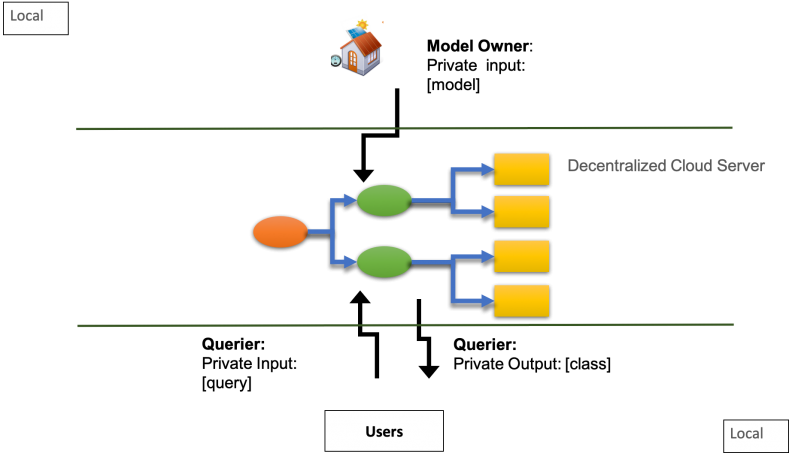
As part of our ongoing review of secure data processing in the cloud, we move now to the analysis of the state of the art (SOTA) for privacy preserving exploration of Decision Trees. That is indeed a fancy description, but, Decision Trees, what are they really? Let us start by saying that they are a […]

CSIDH: post-quantum key exchange using isogeny-based group actions

Discovered back in 1976, the Diffie-Hellman key exchange protocol remains a striking piece of cryptographic functionality that allows for two parties to generate a common secret key while communicating across an unsecured channel that is potentially being eavesdropped. In most textbooks the protocol is explained in terms of exponentiation in groups. That is, the two […]

Questioning the assumptions behind fairness solutions

As we continue to make progress in fairness frameworks to address the discriminatory effects of applying machine learning and optimization to the delivery of digital services, it is important to pause and ask whether service providers have the incentives or the means to implement fairness solutions. Most fairness frameworks today assume that the service provider […]

On Nonlinear Noisy Key Agreement

TL;DR. A large number of post-quantum key encapsulation mechanisms (KEMs) and public key encryption schemes (PKEs) rely on noisy linear algebra problems. Interestingly, the addition of noise to make otherwise easy problems hard, is a strategy that remains restricted to linear algebra and fails to extend to nonlinear operations. This article explores why. Noisy key […]

Jarvis and Friday: STARK-Friendly Cryptographic Primitives

Special thanks to Eli Ben-Sasson and Siemen Dhooghe for reviewing this post before its publication. Tomorrow (Oct. 31, 2018) at the 4th Ethereum Devcon, Eli Ben-Sasson will reveal Jarvis and Friday, two STARK-friendly cryptographic primitives developed in collaboration between COSIC (Siemen Dhooghe and Tomer Ashur) and StarkWare Industries Ltd. This post provides a schematic overview […]

TinyKeys: A New Approach to Efficient Multi-Party Computation

It is sometimes the case that a set of mutually distrustful parties need to perform a joint computation on their private inputs but they are not willing, or cannot afford, to reveal those inputs to each other. This can happen in auctions, data mining, and more generally when someone wants to link, compute and aggregate […]

Constant-time discrete Gaussian sampling for lattice-based cryptography

Since the inception of Lattice based cryptography, discrete Gaussian sampling has been an integral part of it. Recently there are some efforts to replace discrete Gaussian sampling with centered Binomial distributions. These methods work fine for public-key encryption or key-exchange schemes, but for digital signature and trapdoor constructions, discrete Gaussian distributed noise is necessary to […]

Constructions of S-boxes with uniform sharing

Block ciphers are one of the key components in cryptography. Recently, lightweight cryptography became popular and it carried the design approach of a block cipher into different points. Depending on the requirements of the platform: low energy consumption, restriction on area, low multiplicative complexity, resistance against side-channel attacks etc., many new design approaches were proposed […]

Elliptic curves are quantum dead, long live elliptic curves

All currently deployed Elliptic Curve Cryptography (ECC) ideally requires an attacker to solve an instance of the discrete logarithm problem on an elliptic curve E over a finite field Fp with p elements, where p is a prime number. Concretely, his or her task is to find a secret integer n for which P’ = […]