Hardware-Based Trusted Computing Architectures for Isolation and Attestation

Electronic devices pervade our daily lives, both visibly through the devices that we interact with daily, but also invisibly as control industrial control systems and critical infrastructure that we rely on. At the same time, these devices have become increasingly connected, exposing them to remote attackers. The fact that these systems can be exploited is […]

Threshold Crypto and its Application to Collaborative Authentication

With the widespread use of smartphones and wearable devices, such as smartwatches, fitbit devices, in our daily lives, we now have access to sensitive information and different services using such devices. For example, nowadays it is common for most of us to have banking apps installed in our smartphones and do bank transfers, cash withdrawals, […]

Fast, Furious and Insecure: Passive Keyless Entry and Start in Modern Supercars

High-end vehicles are often equipped with a Passive Keyless Entry and Start (PKES) system. These PKES systems allow to unlock and start the vehicle based on the physical proximity of a paired key fob; no user interaction is required. Researchers have already shown these systems to be particularly vulnerable to relay attacks [1, 2]. In […]

Security Evaluations lab

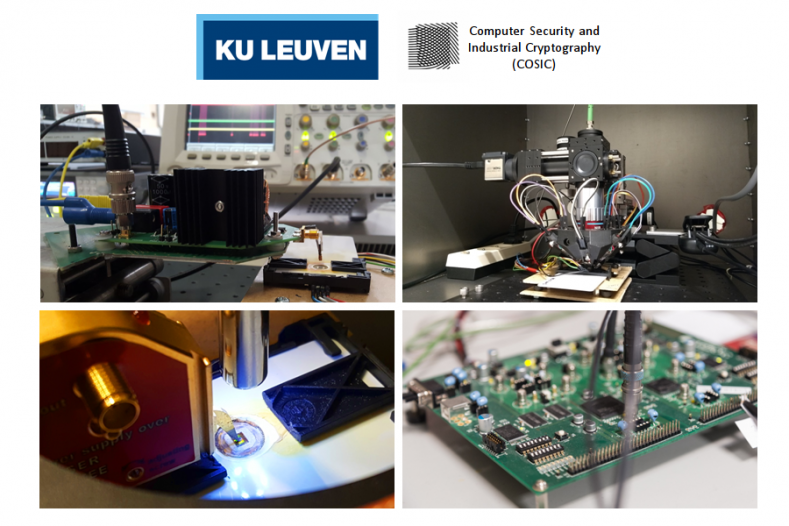
On March 1st 2018, the COSIC research group at KU Leuven officially opened its brand new Security Evaluations Lab. The opening was the culmination of a five-year upgrade project sponsored by a 400k EUR grant from the Hercules Foundation. The Need for Embedded Security Embedded electronic devices are becoming mobile and interconnected. They are omnipresent, […]

How Unique is Your .onion? Analysing of the Fingerprintability of Tor Onion Services

This blog is a description and background of some recent work published at CCS’17. Our goal was to understand how susceptible onion service sites are to a particular set of traffic analysis attacks, called website fingerprinting attacks. Onion service sites are sites that are only accessible using Tor. We focus on particular onion services and […]

Collateral Damage of Facebook Apps

By Iraklis Symeonidis (COSIC, KU Leuven) and Gergely Biczók (CrySyS Lab, BME) Recent technological advancements have enabled the collection of large amounts of personal data at an ever-increasing rate. Data analytics companies such as Cambridge Analytica (CA) and Palantir can collect rich information about individuals’ everyday lives and habits from big data-silos, enabling profiling and micro-targeting of […]

Novel Approaches for Anonymous Communication

One of the fundamental purposes of anonymous communication is to provide a platform for freedom of speech and expressing opinions. The idea is that users feel free to express their opinions in forms, such as public forums, micro-blogging, voting without the fear of being identified by powerful stakeholders such as the NSA and without the […]

The magic toolbox: a new front in the crypto war?

On October 18 the European Commission has presented its agenda for counterterrorism. On page 8-10 of this document the Commission outlines its approach to encryption: supporting law enforcement in criminal investigations. At first sight it is a fairly balanced text that tries to reconcile water and fire. But the devil is in the details and one […]

Privacy-Preserving GWAS is Practical

Nowadays next generation sequencing(NGS) technologies are producing a massive amount of reliable DNA sequencing data at low cost. This makes large-scale whole genome sequencing data accessible for researchers, which has boosted the possibilities for genome-wide association studies. A genome-wide association study(GWAS) aims to identify the association between a genetic variant and a disorder. This is […]