This blog post summarizes this paper which is joint work with Kelong Cong, Emmanuela Orsini and Oliver Zajonc, presented at CRYPTO 2025.
Our work improves the communication cost of multi-party garbled circuits in two phases. We reduce the garbled circuit size and reduce the communication cost of preprocessing.
Never heard of garbled circuits? Then first read this blog post for a gentle introduction to two-party garbled circuits!
Contributions at a glance
- Full row reduction for two flavours of multi-party garbled circuits:
- HSS17-style: reduce the size of the garbled AND gate from 4n\(\kappa\) to 3n\(\kappa\).
- Authenticated garbling: reduce the size of the garbled AND gate from (4n-6)\(\kappa\) to 3(n-1)\(\kappa\).
- Improved preprocessing:
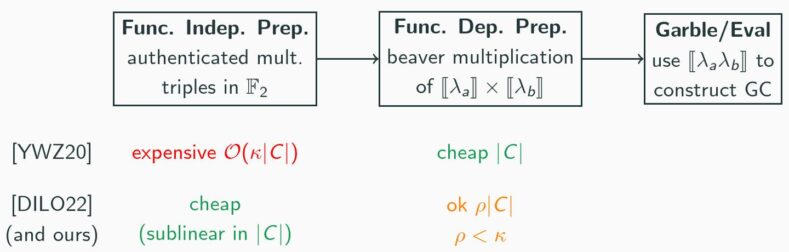
We generalize the approach by [DILO22] to the multi-party setting and obtain function independent preprocessing with sublinear communication cost. Our approach improves the communication cost for large circuits by 6x compared to [HSS17] and 2.2x compared to [YWZ20].
Authenticated Garbling for Multi-Party Garbled Circuits
In the multi-party setting, we cannot have a single garbler anymore, since the garbler knows too much information about the secrets encoding in it. The classic BMR approach is for the parties to jointly create one or more garbled circuits. In the authenticated garbling approach [WRK17,YWZ20], we have only one evaluator but every party (including the evaluator) is a garbler.
The setting we target is active security with dishonest majority. During the garbling phase, all parties create shares of (n-1) garbled circuits and shares of the authentication circuit. The parties send the encrypted shares to the evaluator. The evaluator then evaluates the garbled circuit using similar techniques as in the two-party protocol. Thus, he is able to decrypt exactly one row in each garblers circuit to obtain shares of the next keys. Crucially, the evaluator can reconstruct the next keys after decrypting the circuit of each garbler and check if the shares are correctly formed using the authentication circuit.

Authenticated Garbling (simplified)
For each wire in the AND gate, denoted with a and b for the input and c for the output, all parties hold authenticated bit-shares of three random masks \(\lambda_a, \lambda_b, \lambda_c\) and of the product \(\lambda_a \lambda_b\).
Bits are encoded to each wire label as \(k_0 \oplus (\lambda \oplus x)\Delta\) where k0 is the base wire label, \(\lambda\) the mask and x the encoded bit.
Each party then creates a share of party j’s garbled circuit as follows \(H(k_{a,\hat{a}}, k_{b,\hat{b}}) \oplus \langle k_{c,0}^j \oplus ((\hat{a}\oplus \lambda_a)(\hat{b} \oplus \lambda_b) \oplus \lambda_c)\Delta^j \rangle\) for all four values of \(\hat{a}, \hat{b}\).
This share contains essentially the correct output wire label \(k_{c,0}^j \oplus (\alpha\beta \oplus \lambda_c)\Delta^j\) that is decryptable if the evaluator holds the keys \(k_{a,0} \oplus (\lambda_a \oplus \alpha)\Delta\) and \(k_{b,0} \oplus (\lambda_b \oplus \beta)\Delta\).
Our Row Reduction
Reducing the number of encrypted rows of the garbled circuit of an AND gate has been studied in the two-party setting, where various works have achieved reductions to 3\(\kappa\), … 2\(\kappa\) … 1.5\(\kappa\). However, many of these approaches chose the output key of the AND gate as a function of the input keys. In the two-party setting, this is not a problem. However, in the multi-party setting, where all parties garble together, this means that all AND gates of the computation would not be garbled at the same time since the input of some gates depends on the output of previous AND gates. As such, the garbling phase would no longer be constant-round!
This has been identified by [WRK17] as an open problem which our work now solves. We show a full row reduction while keeping the garbling phase constant round.
The idea is to split the AND equation into three parts: \(\alpha\beta \oplus \lambda_c = (\alpha \oplus \lambda_a)\beta \oplus (\beta \oplus \lambda_b)\lambda_a \oplus \lambda_a\lambda_b \oplus \lambda_c\) where we will denote
- \((\alpha \oplus \lambda_a)\beta\) as prod1
- \((\beta \oplus \lambda_b)\lambda_a\) as prod2
- \(\lambda_a\lambda_b \oplus \lambda_c\) as masks.
We show how to garble and evaluate prod1 with only one ciphertext of size n\(\kappa\) and (n-1)\(\kappa\) for [HSS17] and [WRK17], respectively. Further, prod2 plus masks can be garbled in a single unary gate at the cost of 2n\(\kappa\) and 2(n-1)\(\kappa\) bits.
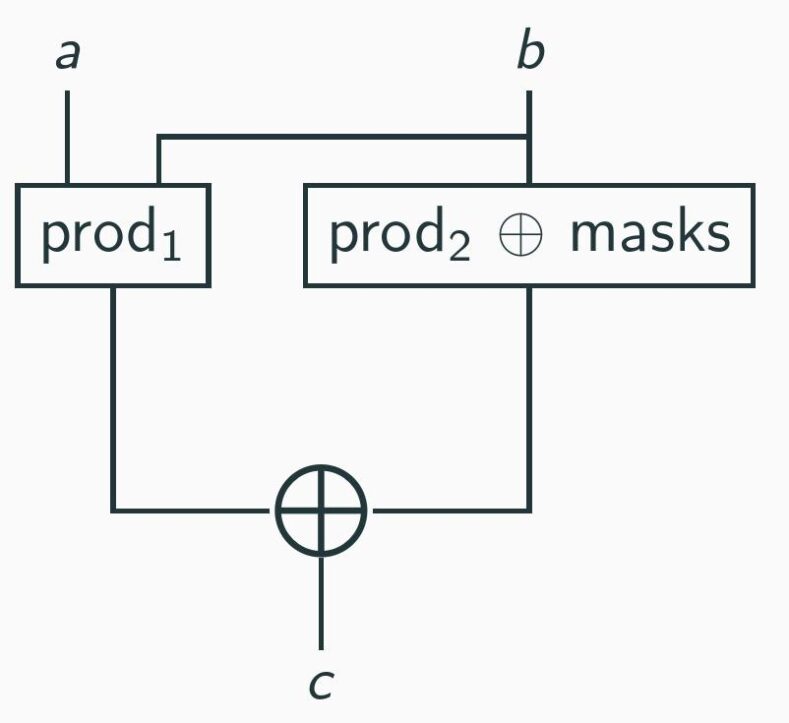
In the following, we give a sketch on how this works in detail in a very simplified (and incorrect) form. See the paper for the correct technical expressions.
Garbling/Evaluating prod1
The parties compute \(H(k_{a,0}) \oplus H(k_{a,1}) \oplus \langle k_{b_0}^j \oplus \lambda_a \Delta^j \rangle\) as their share of party j’s circuit.
Eventually, the evaluator holds \(k_{a,\hat{a}}\) and \(k_{b,\hat{b}}\) of every party and “decrypts” \(H(k_{a,\hat{a}}) \oplus \hat{a}(C_1 \oplus k_{b,\hat{b}})\) where C1 denotes the single ciphertext above.
This yields: \(H(k_{a,0}^j) \oplus (\lambda_a \oplus \alpha)\beta \Delta^j\), which is the correct term offset by \(H(k_{a,0}^j)\). This offset will also be incorporated in every outcome of the prod2 plus masks computation such that it cancels out in the end.
Garbling/Evaluating prod2 + masks
The parties compute the two ciphertexts
- \(H(k_{b,0}) \oplus \langle H(k_{a,0}) \oplus k_{c,0}^j \oplus (\lambda_a\lambda_b \oplus \lambda_c)\Delta^j \rangle\) and
- \(H(k_{b,0}) \oplus \langle H(k_{a,0}) \oplus k_{c,0}^j \oplus (\lambda_a \oplus \lambda_a\lambda_b \oplus \lambda_c)\Delta^j \rangle\).
Now the evaluator, holding \(k_{b,\hat{b}}\) of every party decrypts the \(\hat{b}\)-th ciphertext from above and obtains \(H(k_{b,\hat{b}}) \oplus C_{2,\hat{b}} = H(k_{a,0}) \oplus k_{c,0} \oplus (\hat{b}\lambda_a \oplus \lambda_a\lambda_b \oplus \lambda_c)\Delta^j\).
In the final step, the evaluator XORs the two outputs to remove the offset term \(H(k_{a,0})\).
Improved Preprocessing
The approach of [DILO22] that we extend to the multi-party setting is as follows. Instead of generating authenticated bit-multiplication triples in the function independent preprocessing phase, which are later used to multiply the correct mask terms in a cheap multiplication protocol, we generate authenticated multiplication triples in a larger field (\(\rho < \kappa\) bit) and then use the large multiplication triple to multiply the (bit) masks.
Since the multiplication using a larger multiplication triple incurs more communication, this part is less efficient in terms of communication than using a bit-triple. However, we currently don’t know how to obtain authenticated bit-multiplication triples efficiently. All known constructions suffer from a multiplicative blowup of order of the security parameter. This makes the function independent preprocessing for authenticated bit-multiplication triples very expensive.
On the other hand, there are techniques to obtain authenticated multiplication triples for larger fields with sublinear communication cost. This renders the function independent preprocessing phase extremely efficient in terms of communication.
Our protocol therefore generates authenticated multiplication triples in the \(\rho\)-bit field with sublinear communication and switches the authentication keys from \(\rho\) to \(\kappa\) bits during the multiplication step of the function dependent preprocessing. This switching is also inexpensive due to the use of vector oblivious linear evaluation (VOLE).
Impact
Our full row reduction yields a 25% to 43% smaller garbled circuit compared to the previous state of the art [HSS17,WRK17,YWZ20].
Our improved preprocessing yields a 6x lower communication cost compared to [HSS17] and 2.2x lower communication cost compared to [YWZ20].
Our implementation of the garbling and evaluation phase of the full row reduction is available at github.com/zama-ai/copz25-code.
References
[HSS17] Hazay, Scholl and Soria-Vazquez. Low Cost Constant Round MPC Combining BMR
and Oblivious Transfer. Asiacrypt’17. https://eprint.iacr.org/2017/214
[WRK17] Wang, Ranellucci and Katz. Global-scale secure multiparty computation. CCS’17. https://eprint.iacr.org/2017/189
[YWZ20] Yang, Wang and Zhang. More Efficient MPC from Improved Triple Generation and
Authenticated Garbling. CCS’20. https://eprint.iacr.org/2019/1104
[DILO22] Dittmer, Ishai, Lu and Ostrovsky. Authenticated Garbling from Simple Correlations.
CRYPTO’22. https://eprint.iacr.org/2022/836


