This year, I had the honour of attending the renowned ACM WiSec 2025 conference, held in Arlington, Virginia, USA, from June 30 to July 3. It was an engaging and enriching experience, with many high-quality research presentations across a range of topics in wireless and mobile security. One particular work stood out to me, and I felt it deserved special attention. The paper, titled SoK: Security in the Inaudible World by David Inyangson et al., offers a systematic overview of security challenges in inaudible communication. In this post, I will summarise and reflect on their key contributions, and also share a few thoughts on my experience at WiSec 2025.
Arrival in D.C.: Heat, Humidity, and Architecture
After a direct flight from Brussels, I finally arrived in the United States, landing at Dulles International Airport. The main terminal building, designed in 1958, is a stunning example of American Brutalism by Finnish-American architect Eero Saarinen. I deliberately stepped outside to get a quick look, which you can see in the picture below on the left.
Besides the impressive architecture, I was immediately struck by the intense heat and humidity of the D.C. area, over 34 degrees Celsius with more than 70% humidity. Between the sweltering air and the packed conference schedule, it was clear D.C. would be hot in every possible sense.
After a quick glance at Dulles, I headed to Arlington by metro (yes, the U.S. has one, and yes, it works great). My hotel was conveniently located near the conference venue. Arlington lies just west of D.C. and is easily accessible by metro. The stations themselves are a showcase of American Brutalism, with massive concrete vaults and dramatic lighting, as you can see in the photo on the right.

From left to right: Outside the airport terminal, inside the terminal, and inside the metro station.
WiSec 2025 Venue and Programme
The conference was held in the newly constructed Fuse building on the Arlington campus of George Mason University. The venue felt modern and salubrious, and you can get a glimpse of it in the image below. Coffee and drinks were, of course, complimentary, and attendees were also provided with a lunch sandwich.

From left to right: Outside the Fuse building, inside the building, and the conference room.
The programme covered a wide range of timely and engaging topics, grouped into sessions such as localisation, jamming and interference, Wi-Fi, cellular networks, IoT, and, naturally, ultrasound. I recommend checking out the full programme to explore papers that might be of interest. Every session featured several strong presentations, and choosing which one to highlight in this blog post was not an easy task. However, the paper I will summarise in the following section deserves special attention. It addresses a topic that, in my view, remains under the radar, and I think it is worth shedding more light on it.
Spotlight Paper: Security in the Inaudible World
We are familiar with radio communication technologies such as Wi-Fi, cellular networks, and traditional radio. At their core, these systems rely on electromagnetic waves generated by electronic devices. They work remarkably well and have become integral to our everyday lives.
But what about other forms of communication? For instance, ultrasound (frequencies above 20 kHz) and near-ultrasound (16 to 20 kHz) operate using acoustic waves, mechanical vibrations that travel through a medium such as air. These frequencies are inaudible to humans, yet they open up a different domain for communication and localisation. Most people associate ultrasound with medical imaging, but this technology is also being explored for wireless data transfer, indoor positioning, and device interaction. This raises an important question: what are the security and privacy implications of using inaudible acoustic communication in real-world systems?
This paper sets out to explore precisely that. It presents a systematic overview of the current state of security in the inaudible acoustic domain, highlighting both the potential and the risks of this emerging area. In this blog post, I summarise the authors’ key contributions, refer to their figures and findings, and encourage readers to consult the full paper for a detailed understanding.
Key Contributions
The paper by David Inyangson et al. presents the first systematic overview of the security landscape surrounding ultrasound-based systems. As a systematisation of knowledge (SoK) paper, it makes several important contributions to the field, particularly in an area that has received relatively little attention.
The authors highlight four main contributions:
- They introduce a unified threat model for ultrasound communication systems, enabling consistent comparison across diverse deployments and use cases.
- They review the existing literature and evaluate how different ultrasound systems hold up when analysed under this common threat model.
- They examine the first proposed ultrasound communication standard and discuss its security posture.
- They provide a broader perspective on the current state of ultrasound technology and outline key future research directions.
In the remainder of this section, I will briefly walk through each of these contributions.
Building a Unified Threat Model for Inaudible Systems
While considerable research has been done on ultrasound and near-ultrasound communication schemes, most of these works focus on enabling functionality rather than addressing security concerns. The authors define a general threat model tailored for ad hoc wireless ultrasound networks to bring structure to this fragmented space.
The model considers an adversary with both passive and active capabilities. Passive capabilities include eavesdropping, where the attacker listens in on the communication between a sender and a receiver. On the active side, the adversary may inject malicious messages, disrupt ongoing communication, impersonate legitimate nodes, or perform distance fraud attacks. Notably, this threat model shares similarities with traditional radio-based communication systems. The authors establish a foundation for consistent evaluation by framing ultrasound systems within this model. This enables researchers and practitioners to assess how well existing ultrasound solutions stand up to common security threats and where significant gaps remain.
Putting the Literature to the Test
The authors conducted an extensive literature review, focusing on works that use ultrasound as a physical channel for communication. They prioritised identifying papers that present usable applications rather than purely experimental setups. Many of the reviewed papers came from outside the security domain and, therefore, did not consider security aspects at all. From this review, the authors identified three primary use cases for ultrasound in IoT contexts:
- Location-Based Services (LBS)
- Localised Communication
- Authentication and Secure Session Establishment
In total, they analysed around 30 papers, applying their unified threat model to assess whether the proposed systems could resist common attacks. This analysis revealed how different designs fare under realistic threat assumptions and highlighted areas where security is often overlooked.
In the following subsections, I summarise the key findings for these three use cases. For a deeper dive, the full paper provides a comprehensive breakdown of each system and its vulnerabilities.
Ultrasound for Location-Based Services (LBS)
LBS systems rely on reference nodes to determine the position of an unknown node using ultrasound. Common techniques include Time of Flight (ToF) and time difference of arrival, enabling localisation with room-level accuracy. The paper presents key takeaways on how these systems fare under different types of attacks. Below are the most important findings.
Eavesdropping: Most LBS systems lack encryption, leaving them highly vulnerable to passive eavesdropping. An attacker can easily capture sensitive location information simply by listening in.
Denial of Service: Ultrasound-based systems are particularly susceptible to disruption through unconventional means. Factors such as noise interference, temperature variation, and physical obstacles can all be exploited by an adversary to execute denial-of-service attacks, often in ways that do not affect RF-based systems.
Message Injection: Only a few systems address the risk of message injection. Those that do often rely on transmitter codes, which can suffer from weak seeds and infrequent updates. This highlights the need for more robust cryptographic protections in future designs.
Distance Fraud: Most LBS systems are vulnerable to distance fraud due to unaddressed factors like temperature shifts and multipath reflections. However, the authors argue that ultrasound’s physical-layer characteristics actually offer strong potential for effective distance fraud protection. These properties can be leveraged through distance-bounding protocols and environmental sensing to detect and prevent such attacks.
Spoofing: Some LBS implementations incorporate techniques that enhance location verification and reduce the risk of spoofing. These methods provide a valuable foundation for future designs aiming to secure positioning systems against deception.
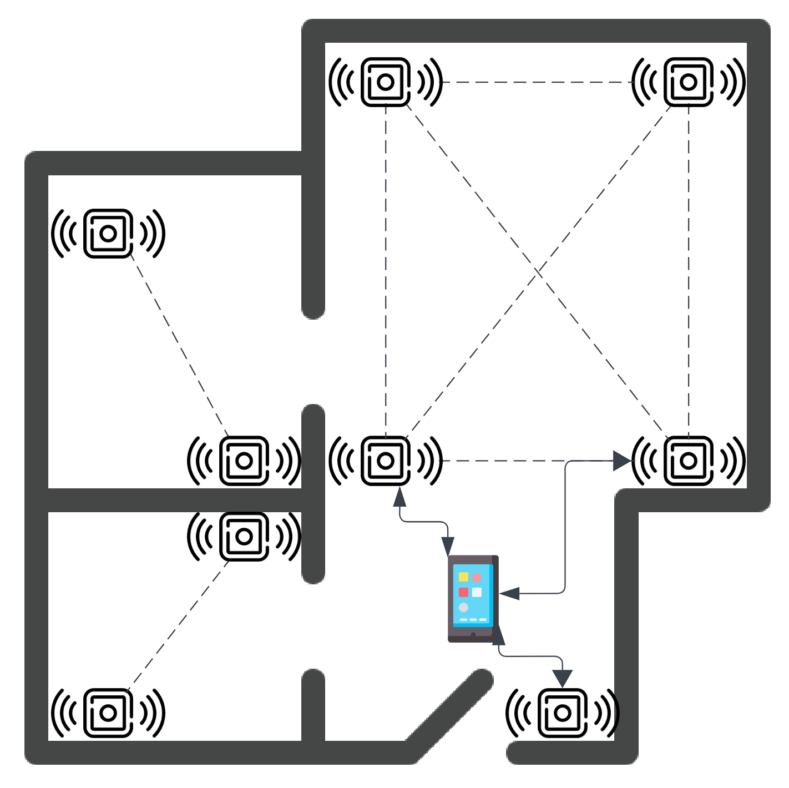
Location-Based Services: Nodes cooperate to localise the positions of newly joined nodes.
Localised Communication
Another important application of ultrasound is as a general-purpose, ad hoc communication protocol for devices in close proximity. Ultrasound is well suited for interactions between a wireless keyboard and a desktop computer or between a museum exhibit and a visitor’s smartphone. As in the previous use case, the paper presents key takeaways on how these systems perform under various types of attacks. The most important findings are summarised below.
Eavesdropping: Ultrasound’s natural signal attenuation can help reduce the risk of eavesdropping. However, since devices cannot prevent a mobile adversary from moving into reception range, physical properties alone should not be relied upon as a security mechanism.
Denial of Service: Like RF systems, ultrasound is vulnerable to physical-layer jamming. Modulation schemes that are more resilient to interference can help mitigate this threat.
Message Injection: Many systems assume message injection is infeasible due to directional signals and limited range. However, this assumption is weak in practice, and ultrasound-based systems should include explicit protections against spoofed or injected messages.
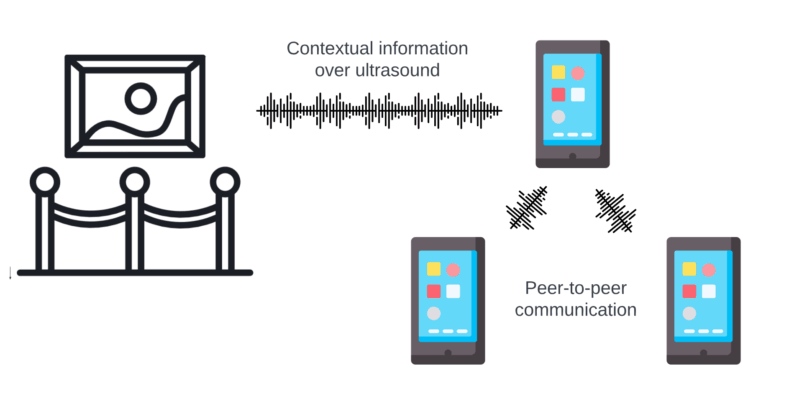
Localised Communication: Devices communicating to propagate exhibit related information.
Authentication and Secure Session Establishment
Ultrasound is also used to authenticate devices and establish secure sessions through key exchange. This enables close-range pairing and secure communication without relying on traditional radio interfaces. As with the other use cases, the paper presents key takeaways on how these systems hold up against various attacks. The most important findings are summarised below:
Eavesdropping: Specialised hardware can offer stronger protection against eavesdropping. At very high frequencies (around 2 MHz), signal attenuation becomes so significant that protocols can approach information-theoretic security. However, such frequencies are not achievable with typical consumer devices, limiting this approach in practice.
Denial of Service: Unlike traditional wireless ad hoc networks, where denial-of-service attacks usually target the network or transport layers, ultrasound-based systems are vulnerable at the application layer. An attacker can repeatedly trigger device responses, such as waking a sleeping device, to exhaust its resources.
Message Injection: Due to the directional and short-range nature of ultrasound, some systems assume message injection is not a serious threat. However, the feasibility of this attack depends heavily on hardware design. In general, robust cryptographic defences are lacking in many of these protocols and should be considered essential.
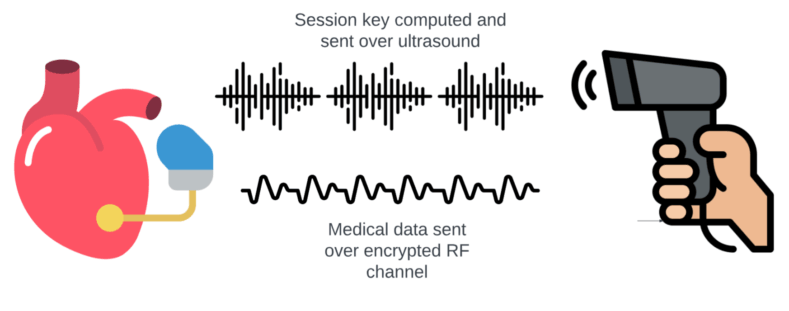
Authentication and Secure Session Establishment: An implantable medical device authenticates an external reader.
Analysing the First Ultrasound Communication Standard
SoniTalk, developed by Matthias Zeppelzauer and Alexis Ringot, is currently the only proposed standard for ultrasonic communication. Submitted as an IETF draft, it failed to gain widespread adoption. In their analysis, the authors apply their taxonomy to examine possible reasons behind this limited interest.
Key Limitations
Lack of Connection Establishment Mechanisms: The protocol does not define how two devices should establish a connection, which is essential for enabling features such as encryption and secure data exchange.
Lack of Interoperability: SoniTalk is tailored for narrowband communication in the 18 to 22 kHz range. However, it does not provide a mechanism for devices to negotiate or agree on compatible communication parameters.
Inadequate Security and Robustness Guarantees: The protocol focuses solely on the physical layer and does not incorporate adequate security measures or integrity checks to protect the transmitted data.
Overall, the paper highlights that SoniTalk suffers from a key limitation: it defines only part of the protocol stack. For an ultrasound communication protocol to be viable, it must address connection establishment, interoperability, security, resilience, and data integrity across multiple layers of the system.
The Road Ahead for Ultrasound Security
Using their taxonomy, the authors provide a structured analysis of current limitations in ultrasound-based systems and outline promising directions for future research. The key insights are summarised below.
Misguided Assumptions: Ultrasound systems are sometimes believed to offer inherent security due to their physical properties, such as signal attenuation and line-of-sight requirements. However, this assumption can be misleading, especially when systems lack formal defences or cryptographic guarantees. Applying threat models traditionally used in radio-frequency technologies would help uncover vulnerabilities that may otherwise go unnoticed.
Security Limitations Compared to RF Protocols: Protocols such as Bluetooth Mesh and Wi-Fi Direct include well-established features like message integrity checks, replay protection, redundancy mechanisms, and recovery techniques. In contrast, ultrasound-based systems often lack these protections and remain vulnerable to data manipulation and denial-of-service attacks. While physical-layer defences like distance bounding and signal directionality are promising, their effectiveness has not been rigorously demonstrated on commodity hardware. Future research should explore how proven defences from traditional wireless networks can be adapted to ultrasound communication.
Lack of Standardisation and Design Guidance: Ultrasound communication lacks a common standard, and most implementations are independently designed and incompatible with one another. This lack of consistency makes systematic evaluation difficult. The authors propose a layered protocol structure that includes key functions at the physical, link, security, and application levels. Features such as secure pairing modes, encryption, error detection, and modulation schemes should be clearly defined across the stack to guide development and enable interoperability.
Conclusion
The paper SoK: Security in the Inaudible World by David Inyangson et al., provides a much-needed systematisation of ultrasound communication security. By introducing a unified threat model, evaluating real-world systems, examining the first standard, and outlining future research directions, the authors offer a comprehensive foundation for future work in this emerging space. Their analysis makes it clear that while ultrasound has promising physical properties for secure communication, assumptions about its safety should be challenged and strengthened through rigorous, layered designs.
From my perspective, this work stood out at WiSec 2025 because it sheds light on a largely overlooked area with growing practical relevance. As ultrasound begins to find its way into localisation, device pairing, and communication systems, the importance of understanding and securing these channels will only increase. The authors provide both a wake-up call and a roadmap for researchers and practitioners who aim to build more resilient and trustworthy systems.


