This blog post summarises the key ideas from the paper ZeroTouch: Reinforcing RSS for Secure Geofencing by Nikola Antonijević et al., presented at ACM SACMAT 2025. The paper explores a novel approach to securing geofencing systems using RSS (Received Signal Strength) measurements, combining lightweight deployment with robust security guarantees.
Geofencing and Wireless Localisation
Geofencing is the concept of creating virtual boundaries around physical spaces, enabling systems to trigger predefined actions when a device enters or exits those areas. Geofences can be defined at various spatial scales, from outdoor regions encompassing entire buildings to precise indoor zones such as individual rooms or corridors. These virtual boundaries are typically enforced using wireless localisation techniques, which aim to estimate the physical position or proximity of a device based on signal measurements.
In the context of wireless systems, localisation relies on physical-layer characteristics of radio signals, including Received Signal Strength (RSS), Time of Flight (ToF), Time Difference of Arrival (TDoA), and Phase of Arrival (PoA). Each method offers a way to infer the distance between a transmitter and receiver by interpreting how the signal behaves as it travels through space. Among these, RSS stands out as the simplest and most widely available measurement, since virtually all wireless devices support it without requiring specialised hardware. However, from a security perspective, RSS is often considered unreliable and vulnerable to manipulation, as its values can be influenced by environmental factors or deliberately spoofed by adversaries.
Geofencing is increasingly used in practical applications such as access control, fleet monitoring, and smart home automation. It also plays a key role in the localisation of Internet of Things (IoT) devices. However, while traditional localisation methods focus primarily on accuracy, secure geofencing brings additional challenges. It is necessary to determine where a device is and do so in a way that is resistant to spoofing, manipulation, or relay attacks. This motivates the need for secure techniques that can reliably enforce geofences, particularly in adversarial settings.
Design Foundations: System and Threat Model
ZeroTouch proposes a simple yet effective system for securing indoor geofences using Received Signal Strength (RSS) measurements. The main idea is to verify whether a device is physically within a protected area, such as a room, without estimating its exact location. This is achieved using a set of pre-installed wireless devices, called anchor nodes, which perform RSS measurements and forward them to a central server.
System Model
ZeroTouch assumes that each secure area contains a number of anchor nodes, which are pre-installed wireless devices located within the geofence. These nodes are connected to a central server and form part of the existing network infrastructure. They perform RSS measurements on incoming signals and securely report them to the server for further analysis. Notably, the system does not require precise knowledge of the anchor nodes’ physical locations. It only assumes that they are within the secure area and maintain a secure connection to the server. This design choice keeps deployment simple and avoids the need for extra calibration or hardware.
In practice, many modern environments, especially homes and offices, already contain several devices that can act as anchor nodes. Wi-Fi routers, smart speakers, smart light bulbs, and other always-on connected devices are well-positioned to perform signal measurements. ZeroTouch can use this natural device density to enforce secure geofences without requiring dedicated infrastructure.
Threat Model
ZeroTouch is designed to defend against external adversaries who attempt to bypass the geofence detection logic. The attacker is assumed to be located outside the secure area and to have knowledge of the anchor node locations. A realistic adversary is equipped with omnidirectional antennas and capable of transmitting at elevated power levels in order to manipulate the RSS readings received by the anchor nodes. The attacker’s goal is to mimic the signal characteristics of an in-zone device and deceive the system into granting access or triggering location-based services. ZeroTouch addresses this threat by detecting inconsistencies in the observed RSS patterns that cannot be easily reproduced from outside the boundary.
Protocol Flow: From Setup to Verification
The protocol flow of ZeroTouch consists of two distinct phases: the initialisation phase and the verification phase. This design follows a train-once, verify-many approach, where the system is first calibrated using trusted in-zone signals and then used to assess whether new devices are physically within the geofence.
Initialisation Phase
In the initialisation phase, the objective is to capture the characteristic RSS profile of the secure indoor space. Anchor nodes located within the geofence exchange messages and record the RSS values received from one another. These measurements are sent to the central server, where a neural network, specifically an autoencoder, is trained to recognise the typical signal patterns observed inside the space.
This is a one-time setup step that only needs to be repeated if the physical environment changes significantly, for example, due to rearranged furniture or structural modifications. The left-hand figure below illustrates how the anchor nodes communicate and send data to the server during this setup phase.
Verification Phase
Once the system is trained, it can verify new devices through the verification phase. When a device, referred to as the prover, transmits messages to the anchor nodes, the anchors collect the RSS values and forward them to the central server. The server then uses the trained model to decide whether the signal pattern matches that of a device located inside the secure area.
All processing is handled centrally. The anchor nodes are only responsible for measurement and communication, which keeps their role lightweight and suitable for deployment on existing home or office devices. This setup allows ZeroTouch to operate efficiently while still detecting attempts to spoof location through signal manipulation.
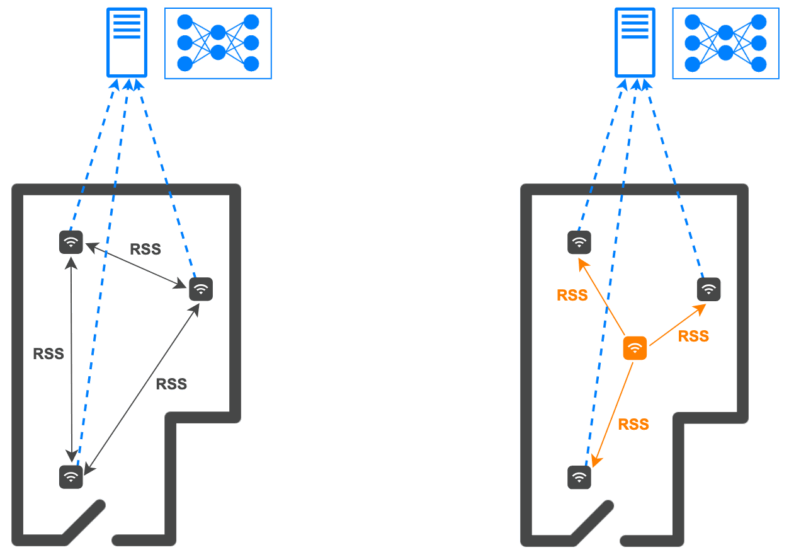
Initialisation (left) and verification (right) phases of the ZeroTouch.
Detecting Signal Manipulation with an Autoencoder
ZeroTouch uses an autoencoder, a neural network trained on normal RSS patterns collected from trusted in-room devices, to decide whether a device is genuinely inside the secure area. The model learns to reconstruct these legitimate signal profiles with very low error. When a new device transmits, the system checks how closely its signal matches the expected pattern. If the reconstruction error is low, the device is classified as inside. If the error is high, this suggests that the signal may have been manipulated to imitate in-room behaviour. Such deviations are treated as potential attacks, for example, attempts to spoof location from outside the secure zone. A predefined threshold, computed using only clean training data, separates normal signals from suspected spoofing attempts. The reader is encouraged to consult the full paper to see more details about the classification process.
Simulation-Based Evaluation
A simulation-based approach was used to evaluate ZeroTouch under diverse and repeatable conditions. This method enabled testing across many transceiver positions and attack scenarios without the logistical overhead of physical experiments.
Wireless InSite, a state-of-the-art ray-tracing tool developed by Remcom, was employed to model indoor radio wave propagation. Key propagation effects, such as reflection, diffraction, scattering, and absorption, were considered. To ensure realism, a complete floor plan of a real apartment building, designed by a practising architect, was imported into the simulation. The layout is shown in the figure below.
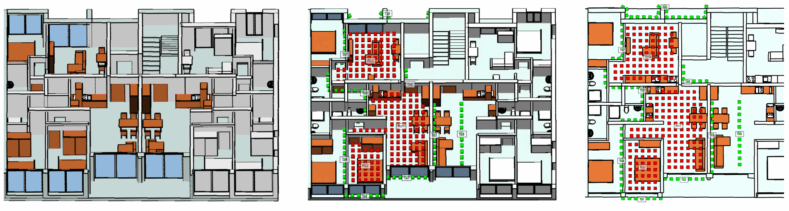
From left to right: apartment layout, measurement points (side view), and measurement points (top view)
Received Signal Strength (RSS) measurements were generated at numerous locations within this environment. Additive white Gaussian noise was applied to the static output to simulate real-world signal variability. Data normalisation was then performed, ensuring zero mean and unit variance across RSS vectors. Autoencoder training was conducted using MATLAB’s Deep Learning Toolbox. Only legitimate in-room signal data was used, following a one-class classification setup. The reader is encouraged to consult the full paper for additional technical detail on the simulation setup.
Evaluation Results
The effectiveness of ZeroTouch was evaluated across a range of realistic adversarial scenarios and deployment configurations. Two primary anchor node placement strategies were considered. In the random placement scenario, anchors were positioned arbitrarily within the secure area, reflecting a fully automated setup without manual intervention. On the other hand, the smart placement scenario involved placing anchors closer to walls, introducing minimal human input to improve detection performance.
In both scenarios, the system was evaluated against strong adversaries capable of spoofing RSS values by increasing their transmission power by 7 dB. Additionally, a power sweep strategy was applied, where the attacker gradually varied transmission power to simulate a broad range of spoofing conditions. These attack models were designed to represent worst-case manipulation attempts. The image below shows the two anchor node placement strategies within the largest room of the simulation environment. On the left, 20 anchor nodes were selected randomly, reflecting the random placement scenario. On the right, 20 anchor nodes were placed near the inner walls, following the smart placement strategy. Blue squares indicate the anchor node positions, while red stars mark misclassifications, meaning cases where an in-room device was incorrectly classified as outside or an attacker located outside was falsely accepted as inside.
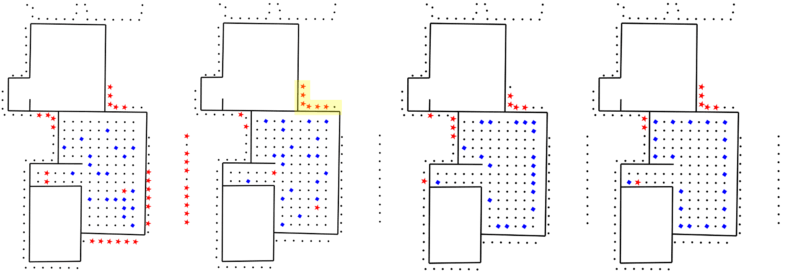
From left to right: two random anchor placement scenarios followed by two smart anchor placement scenarios.
Overall accuracy in the smart placement scenarios was around 95%, compared to roughly 85% for random placement. This highlights the significant impact of anchor positioning on detection performance. Results also depended on the size and complexity of the room: larger or more complex spaces led to lower accuracy when the number of anchor nodes remained fixed. Increasing the number of anchors generally improved classification performance across all room types.
Discussion and Conclusions
ZeroTouch shows that secure geofencing can be achieved using lightweight signal-based methods without requiring additional hardware or complex calibration. By leveraging Received Signal Strength (RSS) measurements from multiple anchor nodes, the system provides a zero-interaction verification layer that integrates seamlessly with existing wireless infrastructure.
A major strength of ZeroTouch is its flexibility. It supports random and smart anchor placement, making it adaptable to different deployment settings. While smart placement improves accuracy, especially with minimal human guidance, random placement remains usable in fully automated environments. The system also allows tuning of the classification threshold, enabling trade-offs between security and usability depending on deployment needs.
ZeroTouch is scalable; each device is verified independently using a pre-trained model. This keeps computation lightweight and supports larger installations without additional complexity. Its compatibility with standard IoT devices further simplifies deployment. The approach applies to various use cases, including autonomous device onboarding, access control in secure zones, healthcare equipment monitoring, and smart home automation. It serves as an added security layer alongside existing authentication systems.
In summary, ZeroTouch offers a practical and efficient solution for secure geofencing. It demonstrates that, when carefully aggregated and processed, even basic signal features like RSS can provide meaningful security guarantees. For more details and further analysis, readers are encouraged to refer to the full paper.


