On Nonlinear Noisy Key Agreement

TL;DR. A large number of post-quantum key encapsulation mechanisms (KEMs) and public key encryption schemes (PKEs) rely on noisy linear algebra problems. Interestingly, the addition of noise to make otherwise easy problems hard, is a strategy that remains restricted to linear algebra and fails to extend to nonlinear operations. This article explores why. Noisy key […]

Jarvis and Friday: STARK-Friendly Cryptographic Primitives

Special thanks to Eli Ben-Sasson and Siemen Dhooghe for reviewing this post before its publication. Tomorrow (Oct. 31, 2018) at the 4th Ethereum Devcon, Eli Ben-Sasson will reveal Jarvis and Friday, two STARK-friendly cryptographic primitives developed in collaboration between COSIC (Siemen Dhooghe and Tomer Ashur) and StarkWare Industries Ltd. This post provides a schematic overview […]

Threshold Crypto and its Application to Collaborative Authentication

With the widespread use of smartphones and wearable devices, such as smartwatches, fitbit devices, in our daily lives, we now have access to sensitive information and different services using such devices. For example, nowadays it is common for most of us to have banking apps installed in our smartphones and do bank transfers, cash withdrawals, […]

Fast, Furious and Insecure: Passive Keyless Entry and Start in Modern Supercars

High-end vehicles are often equipped with a Passive Keyless Entry and Start (PKES) system. These PKES systems allow to unlock and start the vehicle based on the physical proximity of a paired key fob; no user interaction is required. Researchers have already shown these systems to be particularly vulnerable to relay attacks [1, 2]. In […]

TinyKeys: A New Approach to Efficient Multi-Party Computation

It is sometimes the case that a set of mutually distrustful parties need to perform a joint computation on their private inputs but they are not willing, or cannot afford, to reveal those inputs to each other. This can happen in auctions, data mining, and more generally when someone wants to link, compute and aggregate […]

Security Evaluations lab

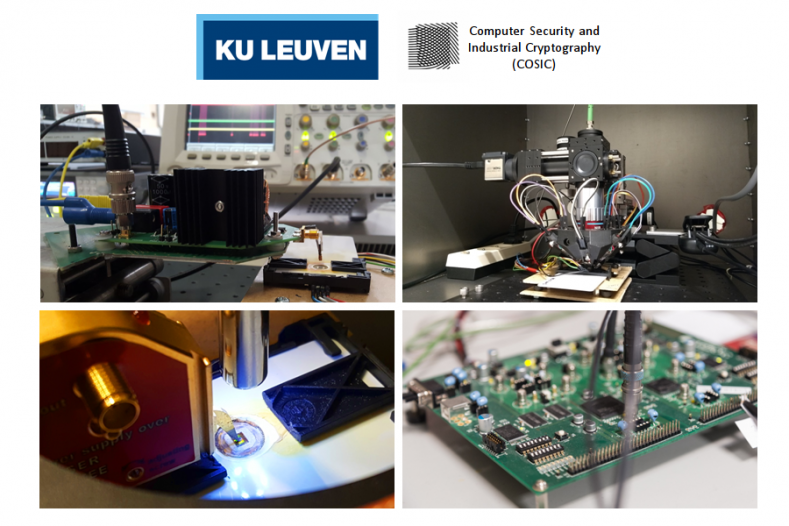
On March 1st 2018, the COSIC research group at KU Leuven officially opened its brand new Security Evaluations Lab. The opening was the culmination of a five-year upgrade project sponsored by a 400k EUR grant from the Hercules Foundation. The Need for Embedded Security Embedded electronic devices are becoming mobile and interconnected. They are omnipresent, […]

How Unique is Your .onion? Analysing of the Fingerprintability of Tor Onion Services

This blog is a description and background of some recent work published at CCS’17. Our goal was to understand how susceptible onion service sites are to a particular set of traffic analysis attacks, called website fingerprinting attacks. Onion service sites are sites that are only accessible using Tor. We focus on particular onion services and […]

Collateral Damage of Facebook Apps

By Iraklis Symeonidis (COSIC, KU Leuven) and Gergely Biczók (CrySyS Lab, BME) Recent technological advancements have enabled the collection of large amounts of personal data at an ever-increasing rate. Data analytics companies such as Cambridge Analytica (CA) and Palantir can collect rich information about individuals’ everyday lives and habits from big data-silos, enabling profiling and micro-targeting of […]

Constant-time discrete Gaussian sampling for lattice-based cryptography

Since the inception of Lattice based cryptography, discrete Gaussian sampling has been an integral part of it. Recently there are some efforts to replace discrete Gaussian sampling with centered Binomial distributions. These methods work fine for public-key encryption or key-exchange schemes, but for digital signature and trapdoor constructions, discrete Gaussian distributed noise is necessary to […]

Constructions of S-boxes with uniform sharing

Block ciphers are one of the key components in cryptography. Recently, lightweight cryptography became popular and it carried the design approach of a block cipher into different points. Depending on the requirements of the platform: low energy consumption, restriction on area, low multiplicative complexity, resistance against side-channel attacks etc., many new design approaches were proposed […]