Silent preprocessing for MPC at CCS’19

Last week there was the famous ACM CCS19 conference in London at Hilton Metropole. Lots of cool security and cryptograpic research, rooms filled with many enthusiastic researchers and at least 6 tracks full of my favorite kind of research – yes, you have guessed that correctly: secure multiparty computation! Tuesday was filled with lots of […]
PPML’19 – Garbled Neural Networks are Practical

The work presented at the PPML 2019 workshop by Mike Rosulek, in collaboration with Marshall Ball, Brent Carmer, Tal Malkin, and Nichole Shimanski, challenges a conventional thought about the non-efficiency of Garbled Circuits (GC) in Neural Network evaluations. Imagine a scenario with two parties: the model owner, who holds a trained Machine Learning (ML) model […]

CCS’19 – “I don’t see why I would ever want to use it”: Analyzing the Usability of Popular Smartphone Password Managers

The work by Sunyoung Seiler-Hwang, Patricia Arias-Cabarcos, Andrés Marín, Florina Almenares, Daniel Díaz-Sánchez and Christian Becker presented at CCS 2019 investigates the usability of popular smartphone Password Manager (PM) applications. Many users struggle in creating and remembering strong passwords. PMs can help them in this task and manage passwords in personal devices. The use pf […]

CCS’19 – Practical Fully Secure Three-Party Computation via Sublinear Distributed Zero-Knowledge Proofs

When we talk about multi-party computation (MPC) we intend a set of techniques allowing multiple parties to jointly compute a function on their inputs, while keeping these inputs private. MPC is very efficient if a small number of parties in involved in the computation. The most efficient solutions are proposed in a semi-honest security model, […]

A High Assurance Evaluator for Machine-Checked Secure MultiParty Computation (CCS’19)

The paper presented in this blog post can be found here. This work was presented at CCS’19 by Vitor Pereira. The area of secure MPC has been progressing rapidly in the past decade both from a theory and an application point of view. In addition to more efficient theoretical protocols, we now have faster implementations […]

Securely Sampling Biased Coins with Application to Differential Privacy (CCS’19)

The paper presented in this blogpost can be found here. This paper was presented at CCS’19 by Jeffrey Champion. Being able to securely sample biased coins is a fundamental problem in a range of areas. Indeed, the problem of securely sampling from specific distributions (e.g. gaussian, exponential, …), can be reduced to the ability of […]

Sparse-secret LWE at WAHC’19

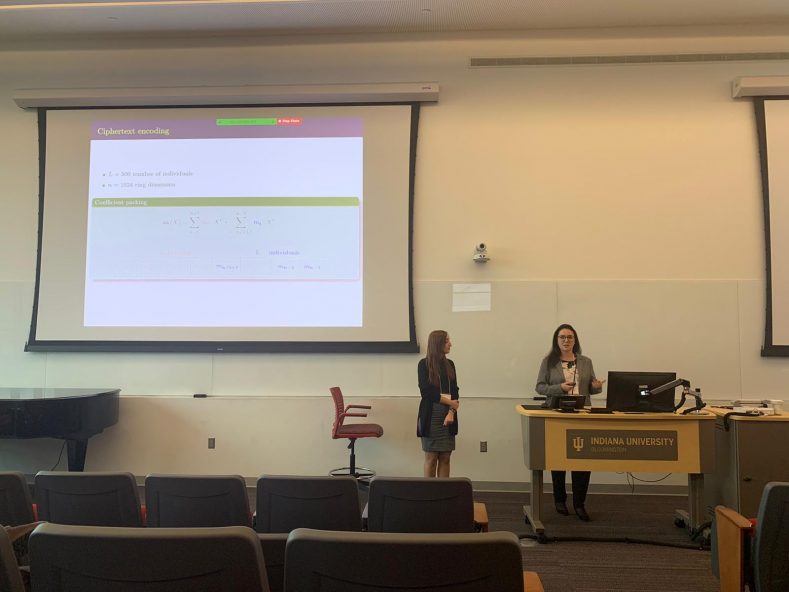
On Monday a bunch of COSIC researchers attended the WAHC workshop, which stands for Workshop on Encrypted Computing & Applied Homomorphic Cryptography. Two COSIC correspondents, Ilaria and Ilia, share their feelings about some of the talks presented at this venue. Ilia: Ilaria, what was the first talk about? Ilaria: Thanks, Ilia. Let me give you […]

iDASH 2019 – KU Leuven among the winners

iDASH (Privacy & Security workshop) is a competition that revolves around the secure analysis of genomic data, organized by the Department of Biomedical Informatics at UCSD, the School of Biomedical Informatics at UTHealth and the School of Informatics and Computing at Indiana University. The competition have taken place every year since 2014 with the goal […]

[CRYPTO 2019] Noninteractive Zero Knowledge for NP from Learning With Errors

Zero knowledge proofs are standard primitives in cryptography. In this setting, a Prover \( P \), using a secret witness \( w \), wishes to convince a verifier \( V \) that a certain statement holds true (formally that \( x \in \mathcal{L} \)). In particular, in this work [1], Peikert and Shiehian focus on […]

[SAC2019] A DFA Attack on White-Box Implementations of AES with External Encodings

[This blogpost is based on a talk titled A DFA Attack on White-Box Implementations of AES with External Encodings by A. Amadori, W. Michiels and P. Roelse @ SAC2019] The classical attack model on cryptographic algorithms is in the so-called black-box scenario, where the mathematical security of a cipher is uniquely deduced by observing the input and […]