Leakage Distribution Network for Masking Schemes

Masking schemes, such as Threshold Implementations (TI), are the most popular technique for countering side-channel attacks (SCA). They decorrelate  the computation from the resulting physical emanations by splitting the target function into multiple shares. For example, a variable \(x\) can be shared into \(N\) shares by randomly generating \(N-1\) values \(x_1\), …, \(x_{N-1}\) and calculating \(x_N\) such […]
Algebraic Cryptanalysis: A Short Introduction

Cryptanalysis is the study of analyzing ciphers or systems in order to reveal hidden secrets. As its name indicates, algebraic cryptanalysis is a type of cryptanalytic methods that mainly exploit algebraic techniques such as equation-solving algorithms. Algebraic cryptanalysis turns out to be powerful when it comes to the ciphers with simple algebraic structures such as […]

The Three Musketeers of Secure Computation: MPC, FHE and FE

From the beginning, cryptography took care of the protection of data. At first the data to be protected consisted of messages in transit, that had to be hidden from adversaries trying to intercept a communication. Lately, with the advent of modern computers and portable memory devices, cryptography also had to protect the data in storage. […]

Does DoH imply Privacy?

Does the deployment of DoH provide as much privacy as claimed? In this blog post we present a privacy analysis of the DoH protocol that sheds light on this question. Our results show that despite the use of encryption, DoH traffic still reveals the web pages that users visit, which enables monitoring of user behavior […]

Generalising Cryptographic Problems from Linear Algebra

With the advent of quantum supremacy seemingly just around the corner, the lifespan of much of the currently deployed public-key cryptographic protocols appears set to be cut short. This is because most of these protocols rely on the hardness of the integer factorisation or discrete logarithm problem and it is well known that Shor’s algorithm […]

CSI-FiSh: a new record class group computation and fast isogeny based signatures

CSIDH is an efficient isogeny based key agreement protocol that generalizes Diffie-Hellman key agreement to the setting of commutative group actions and is assumed to be quantum safe, i.e. it resists attacks by a quantum computer. A detailed overview of CSIDH was given in a previous blog post by Wouter Castryck, where he explained how […]

Hardware-Based Trusted Computing Architectures for Isolation and Attestation

Electronic devices pervade our daily lives, both visibly through the devices that we interact with daily, but also invisibly as control industrial control systems and critical infrastructure that we rely on. At the same time, these devices have become increasingly connected, exposing them to remote attackers. The fact that these systems can be exploited is […]

How to compute on secrets?

Traditionally, cryptography is thought of as a tool for encrypting sensitive data that is sent between two communicating parties or stored in an insecure place. Any party willing to compute on this data must first decrypt it. But what if we want to delegate computation on our precious numbers while nevertheless keeping them secret? This […]

Hare and Tortoise race in post-quantum cryptography: Using SIMD and Just-In-Time for fast and compact key encapsulation mechanism

It has been more than a year since the submission of candidates for the first round of NIST’s post-quantum cryptography started (Candidates qualifying for 2nd round announced on 30th January 2019 ). During this period, we have seen extensive and enthusiastic discussions, analysis and debates among researchers working in this field which has led to […]

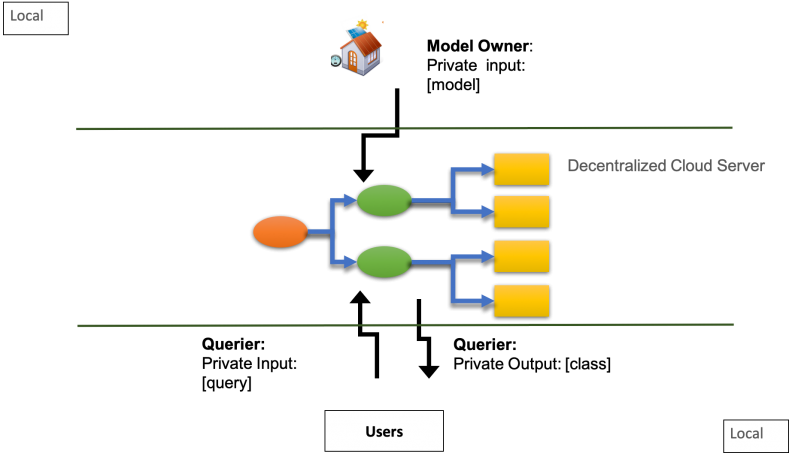
What is up with Decision Trees for Machine Learning, and how can we explore them securely?

As part of our ongoing review of secure data processing in the cloud, we move now to the analysis of the state of the art (SOTA) for privacy preserving exploration of Decision Trees. That is indeed a fancy description, but, Decision Trees, what are they really? Let us start by saying that they are a […]